STORM: Soft Tactile Memory for Safe Physical-AI Correction of Robotic Foundation Models
STORM will investigate how robots can use touch to detect unexpected physical changes and safely adjust their actions. By combining soft, fluid-filled tactile skin with adaptive AI, the project aims to let robots sense and remember contact, recognise risks such as a slipping object, and correct their movements, or stop when uncertainty is too high. It is funded by Independent Research Fund Denmark and begins on 1 March 2027 as a collaboration between Aarhus University and the University of Southern Denmark.
- Funder
- Independent Research Fund Denmark (DFF) Danmarks Frie Forskningsfond · Thematic Research – Research on Artificial Intelligence, 2026
- Principal Investigator
- Behzad Bozorgtabar Adaptive & Agentic AI (A3) Lab, Department of Electrical and Computer Engineering, Aarhus University
- Project co-PI
- Professor Ahmad Rafsanjani University of Southern Denmark (SDU)
- Grant
- DKK 7.2 million in total across AU and SDU
- Partners
- University of Southern Denmark (SDU) SDU Soft Robotics
- Start
- 1 March 2027
Why touch, and what STORM will do
Why touch
Robotic foundation models can already see, read and act. Yet much of what matters in manipulation is felt rather than seen. An object begins to slip, or a grasp lands differently from how it was planned, and a camera may show nothing unusual until the task has already failed. Touch is the sense that reveals when the physical world has stopped matching the robot’s expectations.
STORM starts from this observation and asks how a robot can use touch to detect unexpected physical changes and adjust its actions safely, so that manipulation becomes more reliable under changing real-world conditions.
What STORM will do
The project will combine soft, fluid-filled tactile skin with adaptive AI that lets a robot sense contact and remember it. Every kind of touch leaves its own signature in the signals of the soft skin, and a memory of such signatures will tell the robot what contact to expect as it acts. When the contact it feels departs from what it expects, the robot will be able to recognise risks such as a slipping object and correct its movements, or stop when uncertainty is too high to continue safely.
STORM will study these stages of sensing, memory, risk assessment and correction together, with the goal of safer and more reliable robotic manipulation in changing real-world conditions.
From sensing to safe correction
What the project will study, from a soft skin that feels contact to an action that is corrected or stopped.
-
1 · Sensing
Soft tactile skin turns touch into signals
Contact with the soft, fluid-filled skin is recorded as signals the robot can read.
-
2 · Contact memory
Touch signatures are stored and recalled
Each kind of touch leaves a signature, and a memory of past contact tells the robot what to expect next.
-
3 · Risk assessment
Expected and felt contact are compared
A mismatch, such as an object beginning to slip, is a sign that reality has stopped matching the robot’s expectation.
-
4 · Correction or stop
The action is adjusted, or halted
The robot corrects its movement, or stops when uncertainty is too high to continue safely.
Leadership and collaboration
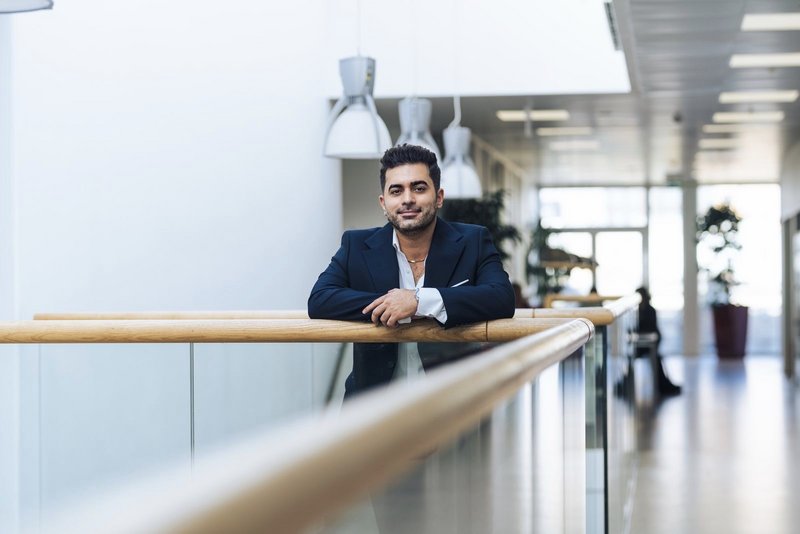
STORM is led from Aarhus University by Behzad Bozorgtabar, Principal Investigator, who heads the Adaptive & Agentic AI (A3) Lab in the Department of Electrical and Computer Engineering. The project co-PI is Professor Ahmad Rafsanjani of the University of Southern Denmark (SDU), and the project’s partners are SDU and SDU Soft Robotics.
The project is a collaboration between Aarhus University and the University of Southern Denmark, with the grant of DKK 7.2 million shared across the two universities. It will begin on 1 March 2027.
Announcement and contact
English version: A sense of touch could help robots handle the unexpected
Academic contact
Behzad Bozorgtabar, Associate Professor, Department of Electrical and Computer Engineering, Aarhus University